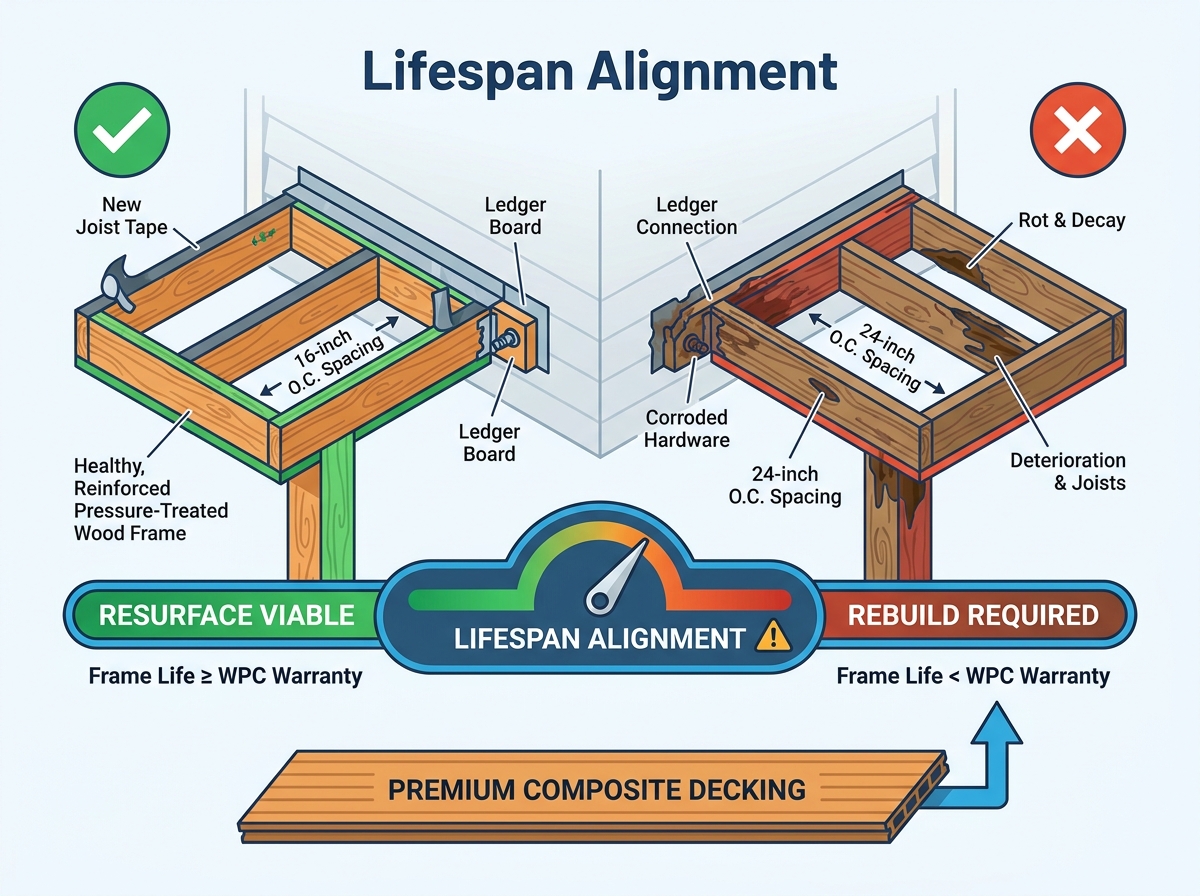
Many homeowners dream of upgrading a deteriorating wood deck surface to modern materials. Salvaging the existing pressure-treated substructure is a common strategy. You save significantly on labor and raw materials. However, this approach carries a hidden danger. We call it the "lifespan mismatch." Installing advanced 25-year materials on a substructure possessing only five years of functional life left invites disaster. If the underlying frame fails early, your entire investment collapses alongside it. This guide provides a strict, compliance-aware evaluation framework. It helps you determine if your current joists and ledger board can safely support an upgrade. You will learn how to inspect for hidden rot, verify structural spacing, and execute mandatory framing remediations. We will walk you through the essential steps to guarantee your old frame is genuinely ready. Your new surface deserves a solid, long-lasting foundation.
Key Takeaways
Lifespan Alignment is Critical: You can reuse a wood frame, provided its remaining structural lifespan matches or exceeds the warranty of your new WPC boards.
Joist Spacing Strictness: WPC materials are heavier and more flexible than wood; older decks with 24-inch joist spacing will require immediate modification.
Ledger Board Vulnerabilities: 90% of deck collapses occur at the ledger board; this connection must pass current local building codes before surface replacement begins.
Moisture Management: Upgrading an existing frame requires specific protective interventions (like joist tape) to prevent accelerated rot beneath the new boards.
1. The Realities of Frame Reuse: Assessing the "Lifespan Mismatch"
Upgrading your deck surface does not magically reset the clock on the underlying structure. The existing posts, beams, and joists continue to age independently. We frequently see homeowners rush to install beautiful new surfaces over compromised foundations. This creates a severe structural imbalance. You are effectively putting a new roof on a crumbling house.
The weight factor plays a massive role in this mismatch. Modern WPC is significantly denser than dry, aged cedar or treated pine. The existing frame must confidently support these increased dead loads. It must do so without deflecting or groaning under pressure. Wood gradually loses its dense cellular integrity over time. Placing heavier materials on weakened timber forces the structure to work harder than ever before. If the frame flexes, the new boards will stress and eventually crack.
You must evaluate the return on investment against the risk of failure. Imagine tearing up newly installed composite materials just three years later. If the underlying posts or joists fail, you have to rip everything apart. Saving 30% upfront on substructure costs seems appealing initially. However, it easily results in a 100% loss of your deck surface investment later. You risk ruining expensive materials during the dismantling process. Removing hidden fasteners often damages the grooved edges of the boards.
2. The 4-Point Structural Assessment Framework
We strongly recommend a methodical inspection before purchasing new boards. This framework isolates critical failure points. It prevents you from building on an unstable foundation. We use these exact metrics during professional field evaluations.
1. Ledger Board and Hardware Code Compliance
The ledger board connects your deck directly to your house. It represents the single most critical structural connection. According to deck safety experts, the majority of catastrophic deck collapses occur right here. Verify the ledger board utilizes appropriate lag screws or through-bolts. Many older decks incorrectly rely on basic framing nails. Nails easily pull out under heavy loads and sheer forces. You must strictly avoid them here.
Inspect the area for proper galvanized or stainless steel flashing. Flashing prevents moisture ingress at the house attachment point. Water trapping behind a ledger board rots your home's rim joist rapidly. Modern residential building codes require rigorous ledger connections. Ensure yours meets current local standards before proceeding with any resurfacing plans.
2. Core Wood Rot and Decay Testing
Visual inspections are rarely enough to diagnose framing health. We rely heavily on the "screwdriver test" in the field. Take a standard flathead screwdriver. Probe the joists, beams, and support posts firmly. Pay particular attention to areas around existing fastener holes. Moisture constantly pools in these tiny depressions. Water seeps into the wood fibers and accelerates decay from the inside out.
You must carefully distinguish between surface weathering and actual wood rot. Surface weathering turns wood gray and causes minor splintering. This is generally acceptable for structural reuse. Soft, punky wood rot is entirely unacceptable. If the screwdriver sinks effortlessly into the timber, the core integrity is gone. You cannot reuse rotten wood under any circumstances. You must cut it out and replace it.
3. Footing Stability and Heave
Your framing is only as reliable as the concrete below it. Assess all concrete footings thoroughly. Look for deep cracking, sinking, or signs of frost heave. Frost heave occurs when freezing ground water lifts the concrete base upward. This cycle destabilizes the entire support structure and warps the framing plane.
Grab a long spirit level. Check the overall plane of the deck across multiple points. If the deck sits entirely out of level due to foundational shifting, stop immediately. Frame reuse is highly discouraged in this scenario. Correcting severe foundation settlement often costs more than building a fresh substructure. You need a stable, unmoving base for modern materials.
4. Fastener Corrosion Assessment
Hardware degrades faster than treated wood in damp environments. Inspect your existing joist hangers, post bases, and carriage bolts. Look for heavy rust or scaling metal. These metal brackets hold the primary structural junctions together.
A light layer of surface oxidation is normal on older decks. However, severely compromised structural hardware must be replaced. Flaking rust indicates lost structural thickness. Do not add a new, heavy surface over failing metal brackets. Swap out questionable hardware before moving forward. Upgrading the hangers requires temporary bracing, but it guarantees joint security for the future.
3. Joist Spacing Requirements for Composite Decking Boards
Structural spacing rules dictate the long-term success of your project. Traditional wood boards can sometimes safely span 24 inches on-center (O.C.). They feature natural rigidity and thickness. Standard composite decking boards require strictly narrower spans. They demand 16-inch O.C. spacing for typical residential applications. They are heavier and inherently more flexible than natural timber. You must measure the precise distance from the center of one joist to the center of the next.
Diagonal installations change these rules completely. Many homeowners love laying boards at a 45-degree angle. Others integrate complex border patterns like picture framing. These designs look incredible and add visual interest. However, they force the boards to span a longer physical distance between joists. Your joist spacing must shrink to 12 inches O.C. for diagonal layouts. You must also add extra blocking around the perimeters to properly support picture framing designs.
Ignoring these measurements introduces a massive sagging risk. WPC possesses unique thermal expansion properties. It softens slightly under intense summer sun. Installing composite on widely spaced joists leads to undeniable bowing. The material droops between the spans as it heats up. This causes structural failure under normal walking loads. The boards develop a permanent, ugly wave. More importantly, this specific error instantly voids most manufacturer warranties. Manufacturers will not replace boards damaged by improper substructure spacing.
Table 1: Joist Spacing Requirements for WPC Upgrades
Installation Layout
Wood Decking Span
WPC Decking Span
Risk of Non-Compliance
Perpendicular (Standard)
Up to 24 inches O.C.
Strictly 16 inches O.C.
Noticeable sagging between joists under foot traffic.
Diagonal (45-degree)
16 inches O.C.
Strictly 12 inches O.C.
Immediate voiding of manufacturer structural warranty.
Picture Frame Borders
Standard blocking
12 inches O.C. + tight blocking
Edge collapse and warped perimeter boards.
4. Remediation: Prepping an Approved Frame for Premium Composite Decking
Passing the initial inspection is just the first step. You rarely find an old frame perfectly ready for immediate installation. Remediation ensures your foundation handles the upgrade safely. We consider these steps mandatory for a professional, long-lasting finish.
Sistering joists provides excellent reinforcement for aging timber. You simply bolt new pressure-treated lumber directly alongside the existing joists. This corrects minor bowing and improves overall structural rigidity. Sistering also fixes spacing gaps efficiently. If your old frame sits at 24 inches O.C., adding new joists between the old ones easily achieves the required 12-inch spacing. Use half-inch carriage bolts staggered every 16 inches when sistering lumber together to guarantee stiffness.
Leveling the plane is absolutely non-negotiable. Older wood frames naturally warp and twist over the years. You must plane down high spots using a power planer. Conversely, use specialized structural shims to raise low depressions. You want to create a perfectly flat surface across the entire deck area. Premium composite decking conforms precisely to the substructure below it. Skipping the leveling process creates a terrible, wavy appearance in the final installation. We highly recommend using a string line to verify the entire plane before laying the first board.
Moisture barrier upgrades act as cheap insurance for your frame. The mandatory application of butyl joist tape extends your frame's life significantly. Roll this flexible tape directly over the tops of all existing joists. It seals old nail holes permanently. The tape protects the vulnerable top grain of the wood from future water runoff. It prevents rot from taking hold exactly where the new hidden fasteners sit.
Finally, verify compatibility with modern hardware. Ensure your updated framing integrates seamlessly with modern hidden fastener systems. Use specific WPC decking accessories designed for your chosen board brand. Always match metal types carefully during remediation. Mixing incompatible metals causes galvanic corrosion. This silently destroys older frame hardware from the inside out. Use high-quality stainless steel screws if your coastal or humid environment demands extra protection.
5. Cost-to-Lifespan Analysis: Resurface vs. Complete Rebuild
Deciding between resurfacing and rebuilding ultimately comes down to objective math. We use a clear financial baseline to remove emotion from the process. You need a logical framework to decide your next move confidently.
Consider the shortlist logic for when to resurface:
The existing frame is less than 10 years old and shows minimal weathering.
All primary posts and joists easily pass the screwdriver test with solid resistance.
The framing layout already features 16-inch O.C. spacing natively.
The ledger board utilizes fully code-compliant through-bolt attachments and proper flashing.
Conversely, recognize the absolute signs indicating when to rebuild entirely:
The frame exhibits localized soft rot in critical load-bearing areas.
The structure relies on 24-inch spacing requiring massive, costly sistering across the whole deck.
The concrete foundation demands extensive repair to fix severe frost heave or sinking.
The ledger board shows signs of deep water damage hidden behind the wall flashing.
Establish a strict financial baseline before purchasing any new surface materials. Add up all projected remediation costs thoroughly. Include the price of sistering materials, heavy-duty hardware replacement, premium joist tape, and labor for leveling the deck plane. Compare this total to the cost of framing a brand-new pressure-treated substructure. If remediation costs exceed 40% of a new frame's price, stop patching immediately. A full rebuild becomes the more economically sound decision. It provides a structurally secure foundation completely worthy of your long-term investment. Pushing past the 40% threshold usually leads to diminishing returns and unexpected structural failures down the line.
Conclusion
Reusing a wood frame remains a fully viable project strategy. However, it is highly conditional on a rigorous, objective structural assessment. Never let the desire for upfront cost savings drive emotional decision-making. Building an expensive surface on a dying foundation guarantees future heartbreak and massive replacement costs. Take the time to evaluate every joist, bolt, and concrete footing.
Follow these action-oriented next steps to protect your project:
Hire a licensed deck contractor or structural engineer to evaluate the existing frame independently.
Order your preferred WPC material samples to test color and texture directly in your yard's lighting.
Gather comprehensive quotes for both potential substructure remediation and a complete frame rebuild.
Finalize your decision only after comparing the long-term structural math and local safety requirements.
FAQ
Q: Will installing WPC over an old frame void my warranty?
A: Not necessarily. Most manufacturers allow installation over older wood frames. However, installing boards over improper joist spacing, failing to provide adequate under-deck ventilation, or laying boards on a severely unlevel surface will instantly void most warranties. Always document your remediation steps.
Q: Can I leave the old wood decking on and install composite over it?
A: Absolutely not. Leaving old wood boards in place traps moisture constantly. This causes rapid, unstoppable decay of the original wood. It also adds extreme dead weight to the frame and violates almost every modern installation guideline. You must remove the old surface completely.
Q: Do I need a building permit just to replace the deck boards?
A: You should always check local municipal codes first. Surface replacements sometimes bypass strict permit requirements. However, altering the joist structure, sistering lumber, or repairing the critical ledger board almost always requires one. Pulling a permit ensures your structural upgrades meet basic safety laws.