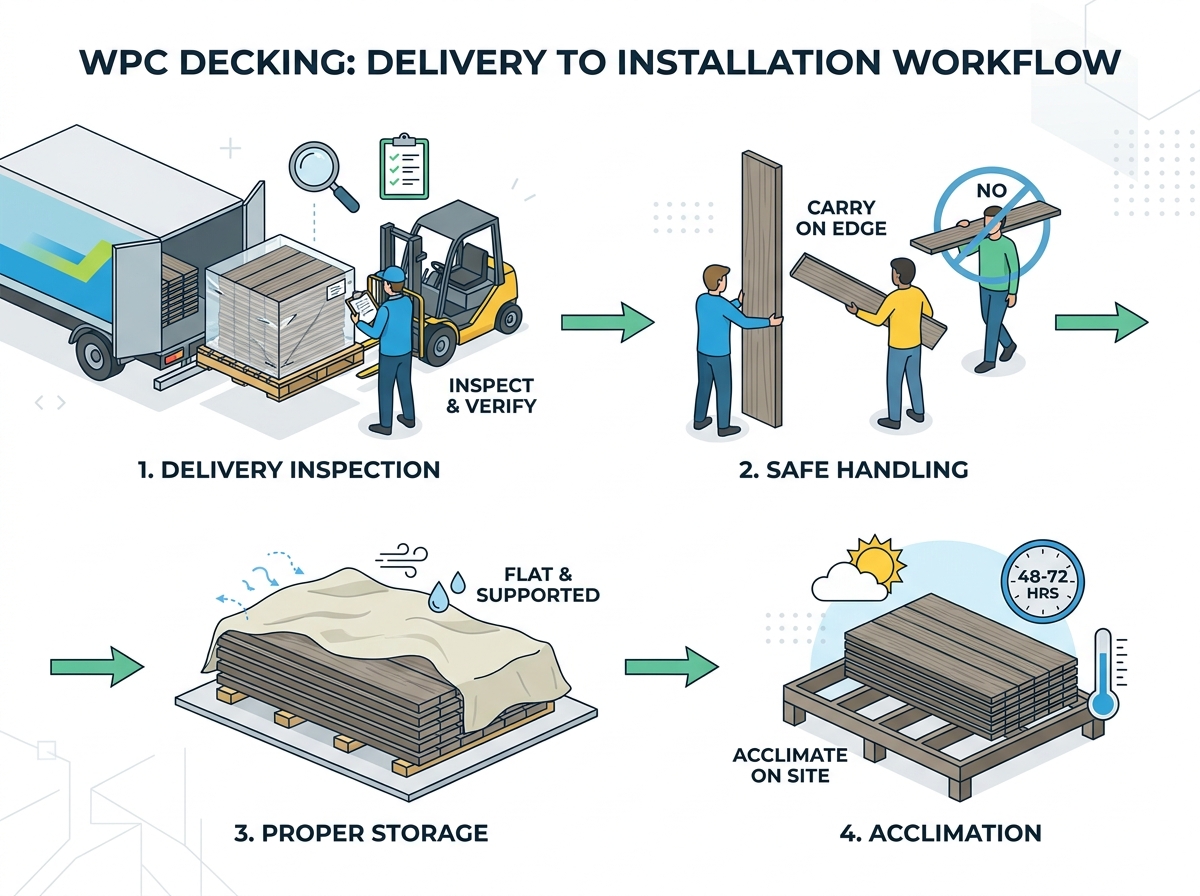
Transitioning from procurement to project execution marks a critical phase in any outdoor build. You finally have the materials on site, ready to transform a blueprint into reality. However, improper handling or storage between delivery and installation frequently invalidates warranties. It also heavily compromises the structural integrity of the build. Builders often discover concealed transit damage much too late. Failing to ensure proper thermal acclimation before cutting also leads to irreversible warping. These preventable errors compromise the final aesthetic and safety of the deck.
This guide equips project owners and contractors with a standardized, compliance-aware protocol. You will learn how to protect your investment from the moment of offload right through to installation. We will cover inspection techniques, proper stacking methods, and precise environmental acclimatization rules. Following these steps ensures your materials perform exactly as engineered.
Key Takeaways
Verify before signing: Always cross-reference the delivery manifest with physical boards and WPC decking accessories before the driver leaves.
Carry on edge, not flat: Prevent bowing and micro-cracking by handling boards vertically during transit across the job site.
Enforce strict acclimation: Materials require a minimum of 48 to 72 hours of site-specific thermal acclimation prior to cutting or fastening.
Support the stack: Store boards on a continuously flat surface with supports every 16 to 24 inches to prevent permanent memory-warp.
Prioritize breathable coverage: Never wrap stacks tightly in non-breathable plastic, which traps moisture and accelerates uneven heat absorption.
The Delivery Day Checklist: Securing Your WPC Decking Investment
Taking delivery of your materials requires immediate and focused attention. You must identify transit damage and order discrepancies while liability still rests with the freight carrier. Once you sign the Bill of Lading (BOL) without noting exceptions, the carrier is released from responsibility. You then assume full ownership of any hidden damages.
Documenting the Unloading
Begin your inspection before anyone breaks the factory banding. Walk around the pallets and look for obvious signs of impact. Take clear, high-resolution photographs of the entire load from multiple angles. If you notice torn shrink wrap, crushed corners, or shifting stacks, document these issues immediately. This photographic evidence becomes critical if you need to file a freight claim. Do not let the driver rush you during this visual inspection.
Manifest Verification
Cross-referencing your delivery manifest requires a systematic approach. Do not just count the pallets. You must verify the specific contents.
Check all SKU numbers against your original purchase order.
Measure a sample of boards to confirm they match the ordered lengths.
Compare color consistency across different batches to ensure a uniform final appearance.
Quantify all shipped hardware, including hidden fasteners, starter clips, and color-matched screws.
Hardware boxes often get lost in transit. Verifying your WPC decking accessories upfront prevents costly installation delays later.
Evaluating Transit Damage vs. Manufacturing Tolerances
Not every imperfection warrants a material rejection. You must differentiate between acceptable surface scuffs and unacceptable structural compromises. Light scuff marks on un-capped boards often fade with weathering. However, you must reject boards with deep gouges, cracked edges, or crushed side-grooves. Damaged grooves prevent hidden fasteners from seating properly. This compromises the holding power of your deck surface. Note any compromised boards directly on the delivery receipt before signing.
Site Preparation and Safe Handling Protocols
How you move materials from the truck to the staging area determines their structural safety. Composite materials possess different physical properties than traditional lumber. They are generally heavier and more flexible. They require specific handling protocols to prevent micro-fractures in the core.
Implementation Realities
First, assess the offload zone carefully. Avoid muddy, uneven, or high-traffic staging areas. Dropping a pallet of decking on uneven ground induces immediate stress on the bottom boards. Choose a flat, dry area as close to the installation site as possible. This minimizes the distance your crew must carry heavy boards, reducing fatigue and accidental drops.
Physical Handling Rules
You must adhere to the "carry on edge" rule. Never carry a long composite board flat like a platter. Carrying boards flat causes them to bounce and flex in the middle. This repetitive bouncing creates microscopic cracks inside the wood-plastic composite matrix. Always turn the board vertically on its edge when carrying it. This utilizes the board's highest point of rigidity. It prevents unnecessary bending and ensures safe transport across the job site.
Protecting the Shell
Advanced composite products require extra care regarding surface friction. When handling co-extruded WPC decking, you must protect the outer polymer shield. Never drag one board across another. Dragging creates friction burns and deep scratches in the protective cap. These scratches compromise the board's moisture resistance and ruin its aesthetic finish. Always lift boards cleanly off the stack. Place them down gently rather than sliding them into position.
Equipment and Labor Requirements
If you use a forklift, proceed with extreme caution. Standard forklift forks can easily gouge the bottom layer of boards. Always use wide fork extensions. Ensure the forks are spaced evenly to distribute the heavy load. Avoid abrupt stops or sharp turns that might cause the load to shift. For residential jobs without machinery, manual unstacking requires two people. One person on each end guarantees safe lifting and prevents dragging.
Best Practices for WPC Decking Storage
Improper storage ruins perfectly good decking before a single cut is made. Composite materials remain somewhat pliable. They will conform to the shape of whatever surface they rest upon. You must create a rigid, flat storage environment to maintain board integrity.
The Flat-Surface Imperative
You must store boards on a continuously flat surface. Storing boards on uneven ground introduces permanent memory-warp. If a board droops over a dip in the ground, the plastic matrix sets into that curved shape. Leaning boards vertically against a wall also causes irreversible bowing. Once a composite board warps in storage, you cannot bend it back into perfect alignment during installation.
Dunnage and Support Spacing
You must elevate the stack off the dirt to prevent moisture wicking. Use structural supports, known as dunnage, to create a level base. Standard timber pieces, like 2x4s, work perfectly for this.
Storage Support Guidelines
Support Type
Maximum Spacing
Placement Requirement
Base Dunnage (Bottom)
16 to 24 inches
Must sit completely level on solid ground.
Mid-stack Supports
Align exactly with base
Do not stagger supports between layers.
Overhang Allowance
Max 6 inches
Do not let board ends sag unsupported.
Recommending structural supports spaced no more than 16 to 24 inches apart guarantees the boards remain flat. Ensure all dunnage aligns perfectly vertically. Staggered supports create pressure points that induce wavy deformations in the decking.
Stacking Limits
Do not build towering stacks of material. Composite decking carries significant weight. Stacking boards too high places immense crushing pressure on the bottom layers. This weight crushes the grooved profiles required for hidden fasteners. Limit your stacks to a maximum height of 10 to 12 boards per bundle. If you must stack multiple bundles, ensure you separate them with aligned dunnage to distribute the weight evenly.
Weather Protection (Tarping Logic)
Weather protection requires a delicate balance. You want to keep debris off the boards, but you must avoid the "greenhouse effect." Never wrap stacks tightly in clear or dark non-breathable plastic. Sun beating down on sealed plastic traps moisture and creates intense heat. This accelerates uneven heat absorption, causing boards to twist. Instead, use light-colored, breathable tarps. Secure them loosely to shed rainwater while allowing ambient air to circulate through the stack.
Material Acclimation: The Science of Thermal Expansion
You cannot uncrate composite materials and install them immediately. Proper acclimation bridges the gap between factory conditions and your specific job site. Understanding thermal expansion ensures your deck frame and surface boards behave predictably.
Evaluation Dimensions (Features-to-Outcomes)
Composite materials react dynamically to their environment. The plastic content expands and contracts with temperature swings. The wood fiber content responds slightly to ambient humidity. When you evaluate these dimensions, you realize why immediate installation fails. Boards cut while artificially cold will expand massively in the midday sun. This closes expansion gaps and causes buckling.
The 48-72 Hour Rule
Industry standards dictate a mandatory acclimation period. Materials require a minimum of 48 to 72 hours of site-specific thermal acclimation. You must complete this period prior to cutting or fastening any boards. Bypassing this crucial step leads to severe post-installation defects. Your deck may suffer from buckling surfaces, gaping end-to-end joints, or sheared hidden fasteners as the boards violently expand or contract.
Site-Specific Conditions
You must adjust your expectations based on transit history. If the decking traveled from a cold northern climate zone to a hot southern job site, it experiences thermal shock. These materials might require closer to 72 hours to fully normalize. Always loosen banding during this time. Tight factory banding prevents boards in the center of the stack from breathing and reaching ambient temperature.
Shade vs. Direct Sun
Acclimation location matters immensely. You must acclimate the boards in the exact environment where they will be permanently installed. If you plan to build a deck in direct, punishing sunlight, do not acclimate the boards in a cool, shaded garage. They will expand wildly once moved to the sunny framing. Conversely, boards intended for a covered patio should acclimate in the shade. Match the staging environment to the final installation environment to guarantee precise gap measurements.
Staging WPC Decking Accessories and Fasteners
While boards receive most of the attention, hardware management dictates the pace of your installation. Disorganized or compromised accessories halt progress immediately. Protecting these smaller components requires just as much discipline as storing the main decking.
Risk Mitigation
Preventing project delays starts with securing your hardware kits. Fastener boxes often arrive loosely packed on top of heavy pallets. Remove them immediately upon delivery. Inventory every box. Discovering you lack enough hidden clips on the morning of installation ruins the project timeline. Lock these components in a secure toolbox or job site trailer to prevent theft or loss.
Moisture Control
Do not leave hardware boxes sitting in damp grass. Storing stainless steel clips, screws, and drill bits in wet conditions risks premature oxidation. Even high-grade stainless steel can develop surface rust, known as tea staining, if exposed to pooled water and construction dust. Cardboard packaging also degrades rapidly in the rain. Store all hardware in a dry, climate-controlled environment until the exact moment you need it.
Workflow Organization
Efficient contractors organize their hardware before framing is even finished. Shortlist and separate your starter clips from the standard hidden fasteners. Starter clips secure the very first board. If they remain buried at the bottom of a mixed hardware bucket, your crew wastes valuable time searching for them. Streamline your first day of installation by staging screws, drill bits, and specialized clips in dedicated, easily accessible containers.
Conclusion
Careful inspection and disciplined storage bridge the gap between a high-quality product and a flawless installation. When you enforce these protocols, you protect your investment from easily avoidable damage. The integrity of your deck relies just as much on pre-installation logistics as it does on carpentry skills. To ensure maximum success on your project, keep these core actions in mind:
Execute a strict delivery audit: Photograph the pallet condition and verify every SKU on the manifest before the carrier departs.
Implement vertical handling: Mandate that your crew carries all boards on their edges to prevent core stress and micro-cracking.
Construct proper storage platforms: Build level, supported dunnage systems spaced every 16 to 24 inches, and cover stacks with breathable tarps.
Enforce the acclimation period: Allow all materials to rest in their final environmental conditions for at least 48 to 72 hours before cutting.
Transitioning from the storage phase, your next step involves finalizing the subframe inspection. Ensure your joists are perfectly level and properly spaced. Gather and organize your required installation tools. With pristine, fully acclimated WPC decking ready to go, you are positioned to build a safe, enduring, and beautiful outdoor living space.
FAQ
Q: Can I store WPC decking directly on the grass or soil?
A: No. Storing boards directly on grass or soil allows moisture to wick into the material and causes uneven temperatures. The ground is rarely perfectly flat, which leads to permanent bowing. Always elevate the boards on level dunnage spaced 16 to 24 inches apart.
Q: How long can co-extruded WPC decking remain stacked before installation?
A: It can remain stacked for several months if stored correctly. Ensure it rests on a flat, properly supported surface out of direct, intense heat. Use a breathable tarp to protect it from debris while allowing air circulation to prevent trapped moisture.
Q: What should I do if I find damaged boards in the middle of the pallet?
A: Document the damage immediately with clear photos. Set the damaged boards aside and do not cut them. Contact your supplier or manufacturer right away to file a warranty or freight claim. Keep the original packaging and labels for reference.
Q: Does rain damage uninstalled WPC decking?
A: Rain itself does not structurally damage composite boards. However, if rain pools unevenly on stacked boards, it can cause water stains or uneven thermal expansion when the sun returns. Loosely covering the stack with a breathable tarp is the best practice to shed water.
Q: Can I acclimate the boards in my garage if it's raining outside?
A: It is not recommended unless the deck will be installed in a similarly shaded, temperature-controlled environment. Boards must acclimate in the exact sunlight and temperature conditions of the final build site. If it is raining, cover them loosely with a breathable tarp outdoors.