
Views: 0 Author: Site Editor Publish Time: 2026-08-31 Origin: Site


Selecting the wrong decking material leads to premature fading, structural warping, and costly replacements within five years. Many homeowners focus solely on color and texture. They completely ignore the rigid engineering requirements of outdoor environments. This common oversight quickly turns a dream backyard into a constant maintenance headache.
You need to shift from merely browsing aesthetics to rigorously evaluating technical specifications. Navigating manufacturer claims requires a solid framework. You must assess environmental suitability and structural integrity for your specific region. Without objective evaluation criteria, you risk buying a substandard product prone to failure.
This guide provides a no-nonsense, evidence-based approach to evaluating manufacturers and comparing material types. You will learn how to mitigate installation risks. We will show you exactly how to match technical specifications to your project demands. By the end, you will know how to make an informed, lasting investment.
Every backyard presents a unique set of environmental hurdles. You cannot install standard boards everywhere and expect uniform performance. Analyzing your specific site conditions is the first crucial step.
Assess your exact installation area closely. Determine if the deck faces prolonged direct sunlight. Heavy UV exposure breaks down polymer chains rapidly. It causes significant surface heat accumulation. If your space features heavy shade or high moisture, your priorities shift. Damp, shaded areas encourage mold and mildew growth. You will need materials engineered specifically for high moisture resistance.
Traffic volume dictates the required density of your boards. A quiet residential patio faces minimal stress. Commercial spaces endure heavy, constant foot traffic. They require high-density cores and superior scratch resistance. Application zones dictate safety needs as well. Pool surrounds and boat docks are high-moisture zones. These specific areas demand enhanced waterproofing. They also require rigorous slip-resistance ratings to prevent accidents.
Evaluate your existing subframe before purchasing new boards. Many people assume they can simply swap old wood for WPC decking. This is a dangerous mistake. Composite materials are heavier than traditional wood. They also exhibit more flexibility. Standard wood decks often use 24-inch joist spacing. Composites require much tighter joist spacing to prevent dangerous sagging.
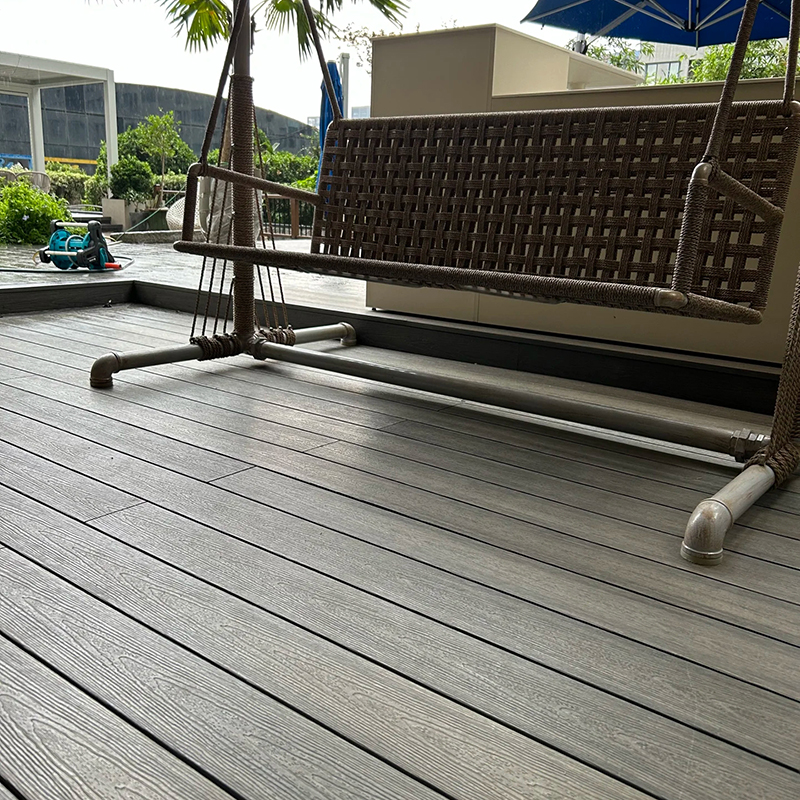
Understanding the generational differences in manufacturing helps you align product capabilities with your expectations. The industry broadly divides products into two main categories.
Manufacturers produce uncapped boards by mixing wood fibers and plastics without a protective outer layer. The wood fibers remain exposed directly on the surface.
Co-extrusion technology encases the composite core in an impermeable polymer shell. Manufacturers fuse this protective shield to the core during production.
You must balance your immediate budget constraints against long-term maintenance expectations. Use the performance matrix below to guide your specific material selection.
| Evaluation Metric | Uncapped Boards | Capped Boards |
|---|---|---|
| Stain Resistance | Low (Highly porous surface) | High (Impermeable polymer shell) |
| Color Retention | Fades up to 20% in first year | Excellent (UV inhibitors included) |
| Surface Temperature | Moderate heat retention | High heat retention |
| Scratch Resistance | Moderate (Can be lightly brushed) | High (Cannot be sanded if pierced) |
| Best Use Case | Low-traffic, shaded residential spaces | High-traffic, full-sun, or dining areas |
You must look past marketing brochures to evaluate true product quality. Focus heavily on these four critical engineering dimensions.
Assess the specific ratio of wood fiber to high-density polyethylene (HDPE). Higher overall density yields significantly better impact resistance. Too much wood fiber leads to aggressive water absorption. Too much plastic creates a brittle board. The best outdoor composite decking balances these elements perfectly. It ensures structural integrity while resisting heavy impacts.
Marketing claims about "fade resistance" mean very little without proof. Look for documented accelerated weathering test reports. Reliable manufacturers test their boards using strict ASTM standards. They expose materials to thousands of hours of Xenon Arc UV testing. Demand to see these lab results before making a purchase.
The Coefficient of Friction (COF) is a critical safety measurement. You must evaluate both wet and dry slip ratings independently. Smooth boards become incredibly dangerous when wet. This metric is especially critical for composite timber decking installed near pool surrounds or water features. Look for deep 3D wood grain textures to enhance mechanical grip.
All polymer-based materials expand and contract constantly. Boards grow longer in intense heat and shrink during freezing nights. You must evaluate the manufacturer's specified expansion tolerances. If a board expands beyond its physical constraints, it will warp or buckle. Understanding these rates dictates exactly how much gapping you need during installation.
A deck is a complete structural system, not just a collection of top boards. Ignoring the underlying mechanics guarantees premature failure.
Modern boards require proprietary hidden clip systems. You must evaluate the quality and durability of these specific fasteners. Stainless steel clips offer incredible holding power. Plastic clips allow for more thermal movement but can snap in freezing weather. You must also factor in the installation speed of these proprietary systems.
Natural hardwoods are incredibly stiff. You can often install them on joists spaced 24 inches apart. Composites behave differently. They typically require 12-inch to 16-inch on-center joist spacing. Diagonal board installations require even tighter 12-inch spacing. Failing to account for this precise engineering requirement leads to catastrophic structural failure and sagging.
Adequate cross-ventilation is absolutely vital for longevity. You must ensure the chosen brand allows for your project's available ground clearance. Boards installed too close to the ground trap evaporating ground moisture. This bakes the boards from underneath. Inadequate airflow immediately voids most structural warranties. It causes rapid, irreversible warping.
Never buy bulk materials based on small digital photos. You need a systematic approach to eliminate inferior suppliers.
Always order physical sample pieces. Once they arrive, subject them to harsh real-world stress tests. Follow these specific steps:
Warranties contain crucial loopholes. You must understand how they operate before a problem arises.
Reputable brands voluntarily submit their products for independent auditing. Demand actual proof of ISO 9001 quality management certifications. Look for FSC-certified wood sourcing logos to ensure environmental responsibility. You should also request independent lab testing documents proving specific fire retardancy ratings and maximum load-bearing capacities.
Choosing outdoor decking is essentially an engineering decision disguised as an aesthetic one. Long-term success relies entirely on matching technical specifications to your specific environmental hurdles. Do not let color choices distract you from structural realities.
Start your project properly today. Calculate your exact square footage first. Define your existing subframe constraints and joist spacing. Finally, order three to five physical samples from shortlisted manufacturers. Begin your real-world stress testing to identify the most durable product for your home.
A: Yes, it generally does. The dense plastic content acts as a heat sink, retaining more thermal energy than natural wood. We recommend choosing lighter surface colors for areas facing prolonged afternoon sun. You should also look for capped boards engineered with specialized cooling technology to mitigate extreme surface temperatures.
A: It depends entirely on the board type. Minor scuffs on first-generation uncapped boards can sometimes be lightly brushed out using a wire brush. However, deep scratches piercing the shell of capped boards cannot be sanded or repaired. You must replace the damaged board entirely.
A: No, you cannot. Installing boards directly on concrete traps moisture and eliminates necessary airflow. You must install a dedicated sleeper system or subframe over the concrete. This raises the boards, provides essential drainage, and prevents severe warping and structural rot.
A: High-quality, co-extruded capped boards typically last 25 to 30 years with minimal maintenance. However, this lifespan is strictly conditional. You will only achieve this longevity if the underlying joist structure, expansion gapping, and ground ventilation requirements are perfectly met during installation.