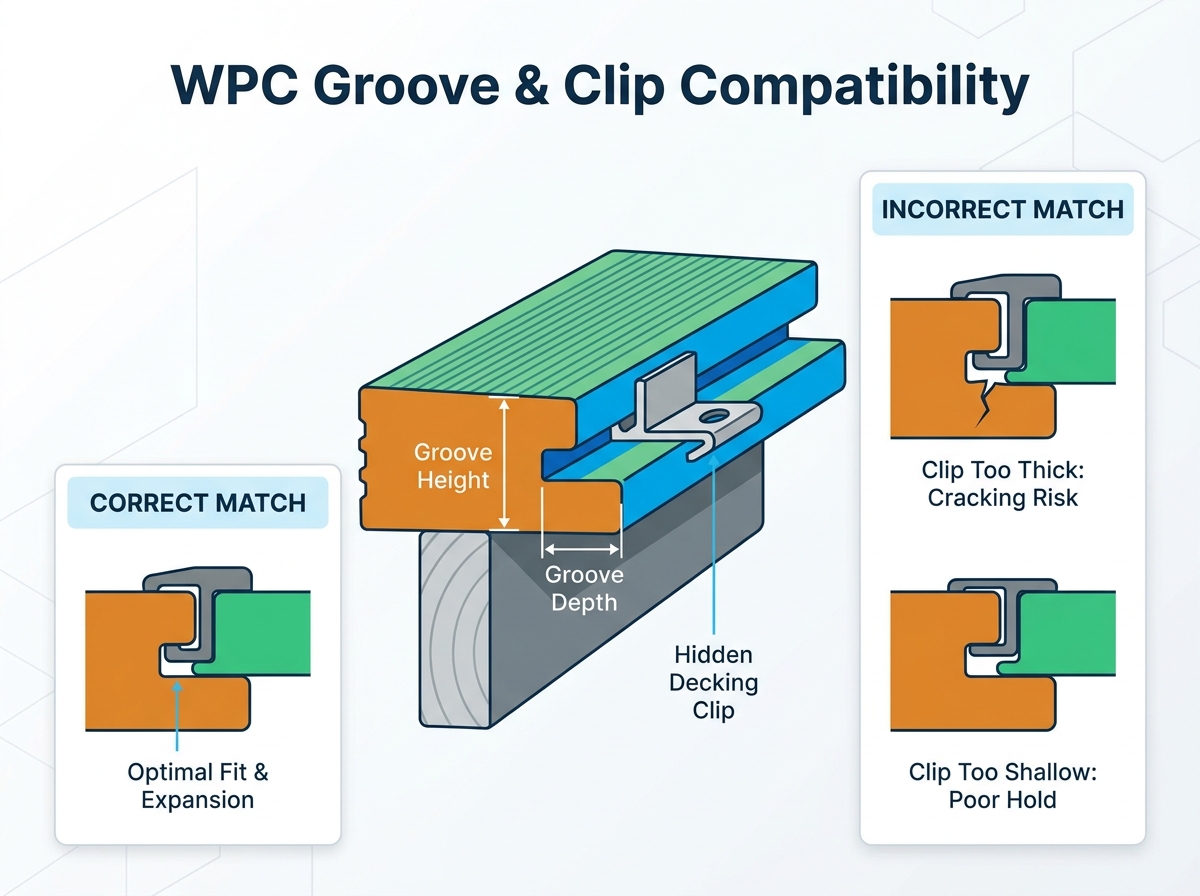
Securing composite decks using incorrect hidden fasteners often leads to loud, squeaking floors. You may also notice uneven board gaps or discover entirely voided manufacturer warranties down the line. Installers frequently assume all decking accessories offer a universal fit. However, standardizing on a single clip type without verifying groove geometry and substructure compatibility remains a common, costly installation error. When fastener tolerances mismatch the board profile, decking can shift, crack, or rattle underfoot during temperature changes.
This guide provides a detailed technical evaluation framework for your next project. We will help you perfectly match your hidden fasteners to specific board profiles and joist systems. You will learn exactly how to ensure long-term structural integrity while maintaining strict warranty compliance across residential and commercial builds.
Key Takeaways
Groove height and depth dictate clip compatibility; mismatched tolerances cause board shifting or cracking under thermal expansion.
Substructure materials (treated timber vs. metal) determine the required screw thread and clip design.
Environmental exposure dictates fastener material selection, requiring a calculated choice between polymer, aluminum, and stainless steel.
Securing the perimeter requires specialized stainless steel starter clips to maintain the fastener-free aesthetic.
Decrypting WPC Groove Geometry: The Foundation of Clip Compatibility
Many installers fall victim to the dangerous myth of universal fit. They purchase generic accessories expecting seamless compatibility across all board brands. However, proprietary edge designs vary wildly between manufacturers. Buying generic hidden composite decking clips frequently leads to catastrophic installation failures. Your fasteners must strictly mirror the specific geometry of the board edge.
Critical Measurement 1 focuses on groove height, also known as vertical clearance. We must evaluate this dimension carefully. If you install a clip exceeding the available groove height, problems arise immediately. Driving the screw down applies immense downward pressure. This excessive force routinely cracks the lower lip of the groove. Cracked boards compromise the entire structural integrity of the deck. Conversely, selecting a fastener lacking sufficient thickness creates the opposite issue. Thin clips fail to provide adequate downward pressure. Consequently, the boards will inevitably rattle, shift, and lift away from the joists over time.
Critical Measurement 2 addresses groove depth, or horizontal penetration. Horizontal engagement dictates lateral stability. As seasons change, composite materials undergo significant lateral thermal expansion and contraction. The clip wing must engage deeply enough into the side channel. This deep engagement securely holds the board during temperature fluctuations. However, the wing must never bottom out against the inside wall of the groove. If the metal or plastic hits the back wall, thermal expansion forces the board out of alignment. Misaligned boards ruin the uniform aesthetic and create dangerous tripping hazards.
Common Groove Matching Mistakes
Assuming all grooved boards share an identical 4mm side channel.
Forcing oversized metal wings into narrow grooves using a rubber mallet.
Ignoring the vertical clearance gap, leading to inevitable floor squeaks.
Matching Clip Material to Environmental and Structural Demands
Environmental exposure strictly dictates your material selection process. You must carefully weigh the physical properties of each option before starting construction.
Polymer or plastic fasteners offer distinct advantages for many residential projects. They provide complete corrosion resistance against rain, snow, and ambient moisture. Furthermore, plastic naturally accommodates minor board expansion without causing friction squeaks. However, polymer solutions carry notable drawbacks. They frequently become brittle when exposed to extreme cold climates. Plastic also provides lower sheer strength compared to metal alternatives. Heavy commercial traffic might require stronger hardware.
You might specify aluminium decking clips for their unique structural benefits. Aluminium delivers exceptional high tensile strength. It remains incredibly lightweight while providing a rigid, uncompromising hold. Despite these benefits, installers must navigate serious chemical risks. Severe galvanic corrosion occurs frequently if you pair aluminium alongside certain treated lumber joists. Alkaline Copper Quaternary (ACQ) treated timber reacts aggressively against unprotected aluminium. You must install a high-quality butyl barrier tape to prevent this chemical reaction. Installers must also thoroughly evaluate the powder coating quality before purchasing aluminium fasteners.
Stainless steel remains the definitive standard for high-end residential and commercial installations. We evaluate stainless steel based on two primary grades: 304 and 316. Decision logic follows a simple environmental rule. You should specify 304-grade steel for standard inland environments. It handles moderate humidity and seasonal rain perfectly. Conversely, you must upgrade to 316-grade steel for coastal, saltwater, or pool-side applications. Airborne salt and pool chemicals present severe corrosion risks. The 316 marine-grade alloy contains molybdenum, which specifically resists chloride-induced pitting.
Material Performance Comparison
Material Type
Corrosion Resistance
Structural Strength
Ideal Application Environment
Polymer / Plastic
Excellent (Immune to rust)
Moderate (Can be brittle in extreme cold)
Standard residential, high moisture areas
Aluminium
Good (Requires barrier tape on ACQ timber)
High (Rigid and lightweight)
Commercial decks, non-corrosive environments
304 Stainless Steel
Very Good
Exceptional
Inland residential and commercial builds
316 Stainless Steel
Maximum (Marine Grade)
Exceptional
Coastal, saltwater, and pool-side decks
Joist Compatibility: Aligning Fasteners with the Substructure
Your joist material fundamentally alters your fastener requirements. A mismatched screw destroys both the clip and the underlying substructure.
Treated timber joists demand highly specific screw designs. Fasteners require coarse threads to achieve sufficient bite into the soft wood grain. Additionally, you should seek out screws featuring reverse threads near the top head. These reverse threads actively push wood fibers down during insertion. This action prevents material mushrooming above the base. Moisture presents another ongoing challenge for timber substructures. Base plates constantly trap water against the damp timber surface. We strongly advise applying waterproof joist tape across every frame member. Tape prevents moisture transfer, stops fungal rot, and eliminates squeaking caused by friction.
Steel or aluminum substructures require an entirely different hardware approach. Fine-thread, self-drilling TEK screws are absolutely mandatory here. You must never attempt using standard timber screws on metal framing. This common mistake carries a high failure risk. Timber threads easily strip out the thin metal walls. You will inevitably encounter sheared screw heads and zero structural holding power. Self-drilling screws cut their own precise mating threads, ensuring maximum pull-out resistance.
Contractors must also evaluate pre-assembled systems versus separate components. Fasteners featuring pre-inserted screws deliver significant labor-time savings. Installers simply drop them directly into place and drive the bit. This single-step motion saves hundreds of hours on large-scale builds. Alternatively, buying components separately offers much-needed flexibility. You can swap out screw types dynamically. This modular approach works perfectly for complex projects utilizing mixed-joist environments.
Managing Perimeters: The Role of Stainless Steel Starter Clips
Deck perimeters introduce a unique fastening challenge. The first and last boards cannot utilize standard dual-sided hidden fasteners. Traditionally, builders relied on face-screwing these outer edges. However, visible screw heads immediately compromise the premium, fastener-free aesthetic of modern decks.
You solve this perimeter problem by implementing a dedicated starting strategy. Use stainless steel starter clips to secure the initial row. These specialized brackets lock the outer edge of the first board directly into the rim joist. The subsequent inner groove then safely receives standard dual-sided fasteners.
Alignment tolerances during this stage require immense precision. A mere 1mm error on the starting row compounds drastically across the deck surface. If left uncorrected, the final board will misalign by several inches at the finishing edge. Installers must run a perfectly straight chalk line before securing the starting brackets.
We highly prefer stainless steel over plastic for these critical edge positions. Perimeter boards endure the highest structural stress, wind uplift, and daily foot traffic impact. Steel brackets guarantee the outer frame remains completely immobilized over decades of heavy use.
Contractor Evaluation Framework: Scalability and Warranty Compliance
Professional installers must evaluate fastening systems based on job site scalability. Labor efficiency directly impacts project timelines and overall success.
Speed of installation varies widely between different fastening systems. Top-down installation designs allow workers to drive screws straight down between the boards. This vertical method works much faster than older, angled installations. Angled screws frequently strip out and frustrate workers. Spacer integration also matters significantly for overall efficiency. Determine if the clips auto-gauge the required 3mm-6mm gap for WPC decking boards. If the system demands manual gapping blocks, workers waste hours measuring every single row. Integrated spacers guarantee a flawless, uniform surface appearance automatically.
Warranty verification serves as your most critical administrative task. Many composite manufacturers explicitly void board warranties if you utilize non-approved fastening systems. They engineer their boards to expand and contract at specific rates. Incompatible accessories restrict this natural movement, causing stress fractures.
Shortlisting Logic for Buyers
Verify exact board groove dimensions using a digital caliper.
Identify your joist material and strictly assess local environmental corrosion risks.
Cross-reference the fastener gap size and expansion allowances with the board’s Technical Data Sheet (TDS).
Request physical samples to test fit the wing engagement depth.
Drive test screws into scrap joist material to verify holding power before ordering bulk pallets.
Conclusion
Sourcing hidden fasteners requires a highly technical matching process. It should never be treated as a generic, afterthought commodity purchase. Mismatched components ruin expensive decking materials, cause loud floor squeaks, and jeopardize structural safety.
Take immediate action by gathering all necessary technical documentation. Obtain the official technical specification sheet for your selected composite materials. Order a small sample pack of targeted clips based on your environmental requirements. Conduct a physical mock-up on your specific joist material. This brief testing phase prevents costly teardowns and guarantees a flawless, silent deck surface.
FAQ
Q: Can I use aluminium decking clips with ACQ-treated pine joists?
A: Only if a barrier (like butyl joist tape) is used between the clip and the wood to prevent galvanic corrosion. Otherwise, stainless steel or plastic is required.
Q: Why are my hidden composite decking clips causing the boards to squeak?
A: Usually caused by inadequate downward pressure (clip height is too small for the groove) or omitted joist tape, allowing plastic/metal to rub against wood during thermal expansion.
Q: Do I need different clips for grooved vs. solid WPC boards?
A: Hidden clips only work with grooved edge boards. Solid boards require either face-screwing, plugging systems, or specialized jig-based edge fastening systems.
Q: How many stainless steel starter clips do I need?
A: Typically calculated based on joist spacing (e.g., one clip every 16 inches / 400mm along the starter and finisher rim joists).