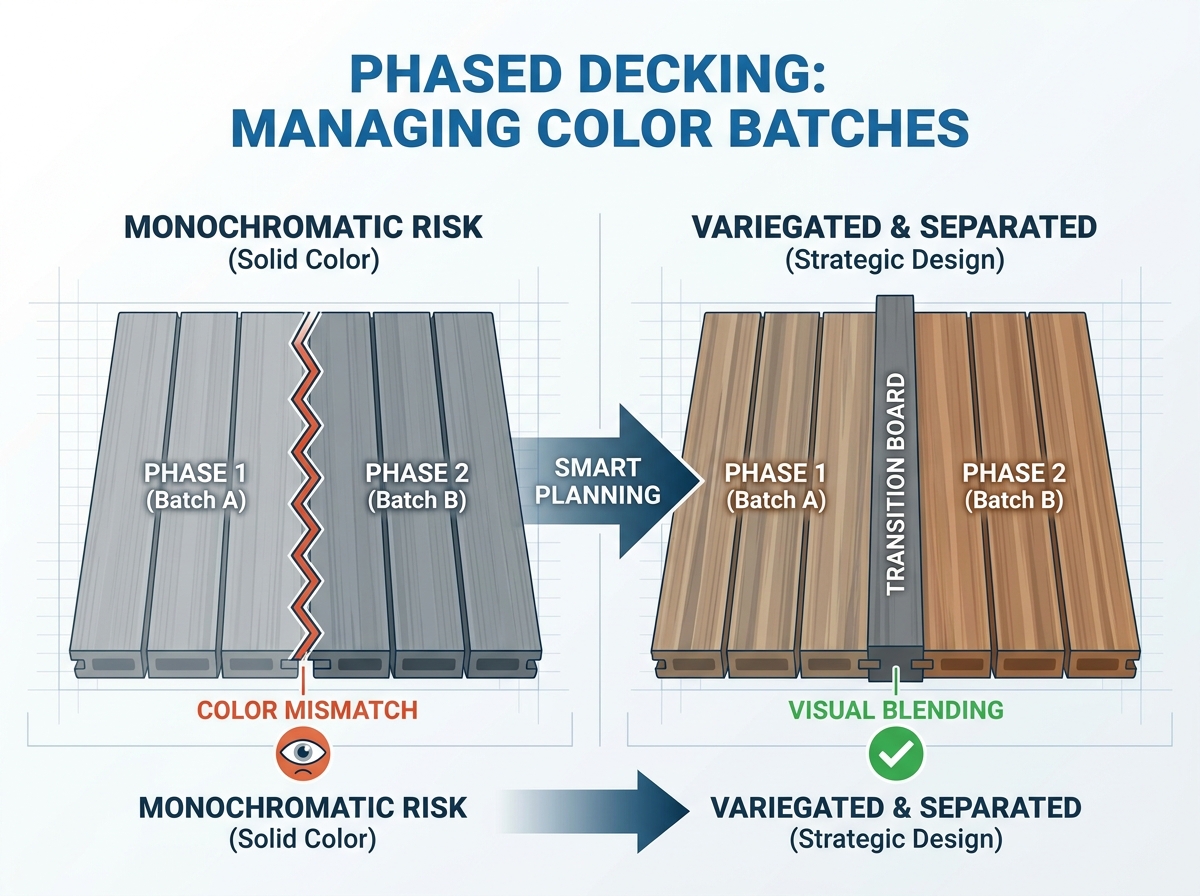
Phased deck construction is a pragmatic way to manage budget constraints. Splitting a project across multiple seasons makes financial sense for many homeowners. However, it introduces a significant design risk. You might face noticeable color mismatches. Distinct manufacturing dye lots rarely align perfectly over time.
Achieving a cohesive look across a multi-stage build requires anticipating these variations early. You must select the right material textures and leverage strategic layout breaks. Utilizing smart procurement logic also helps immensely. Doing so means you can seamlessly integrate distinct batches without sacrificing the final aesthetic.
This guide provides a practical framework for planning multi-phase composite decking projects. It sets realistic expectations for natural material weathering. Furthermore, you will learn to choose products engineered specifically to mask batch-to-batch inconsistencies. Planning ahead ensures your multi-year investment looks cohesive, deliberate, and beautifully finished.
Plan Architectural Breaks: Never run Phase 1 and Phase 2 boards end-to-end; use elevation changes, transition boards, or distinct zones to separate dye lots.
Control the Visibles: Always purchase highly visible, continuous elements—such as composite deck fascia boards—in a single batch to ensure absolute uniformity on perimeters.
Anticipate UV Curing: Understand that even identical batch materials will look different if Phase 1 has been exposed to six months of sunlight before Phase 2 is installed.
The Reality of Manufacturing Batches in Composite Materials
Understanding the manufacturing reality of composite materials helps set proper project expectations. Every production run requires blending raw polymer resins, color pigments, and organic wood fibers. Extrusion temperatures fluctuate slightly during this process. These minor shifts alter the final hue of the finished boards. Consequently, no two production runs are mathematically identical. A batch produced in May will inevitably show slight tonal differences from a batch extruded in October.
We must debunk the "perfect match" myth immediately. Industry marketing sometimes overpromises color consistency. You should approach these claims skeptically. Expecting zero color variation across different years is an unrealistic expectation. This holds true for any synthetic or natural building material. Managing this expectation upfront prevents disappointment during Phase 2 of your build.
Environmental weathering plays an equally critical role in color dynamics. You must differentiate between manufacturing color shifts and natural UV curing. Sunlight breaks down surface pigments over time. A freshly manufactured board will never perfectly match a six-month-old board. They might come from the exact same manufacturing batch, but they will look different. The newer board must undergo its own initial fading cycle before it matches the older material.
Comparison: Manufacturing Variation vs. Natural UV Weathering
Characteristic
Manufacturing Dye Lot Variation
Natural UV Weathering (Curing)
Cause
Slight changes in polymer mix, pigment ratios, and extrusion heat.
Prolonged exposure to direct sunlight and environmental elements.
Visibility Timeline
Immediate upon delivery and unboxing of the materials.
Develops gradually over the first 12 to 16 weeks of sun exposure.
Permanence
Permanent. The baseline color difference remains structurally embedded.
Temporary difference. New boards eventually fade to match older boards.
Mitigation Strategy
Use architectural breaks, variegated colors, and smart layout planning.
Allow new boards time to weather; avoid covering portions of the deck.
Evaluating Decking Types for Phased Color Consistency
Selecting the right visual style determines how well your deck hides future batch discrepancies. Monochromatic or solid-color decking acts as a high-risk choice for phased projects. The human eye easily detects slight tonal shifts on uniform surfaces. Solid colors amplify inconsistencies. If a new gray board sits next to an older gray board, you will spot the seam instantly.
We highly recommend shifting toward variegated aesthetics. Dual-tone extrusion creates inherent, natural-looking visual variance across every board. This is the primary advantage of using double-color capped decking for multi-stage builds. Manufacturers blend two distinct pigment streams during extrusion. This produces organic, streaked patterns similar to exotic hardwoods. Because every board already looks slightly different, the transition between two separate production batches becomes much harder to spot. The inherent chaos of the pattern acts as natural camouflage.
You can also leverage physical surface finishes to your advantage. Deep embossing scatters light reflection across the deck surface. When you choose 3D wood grain WPC decking, you introduce structural texture as a visual disruptor. Light hits the raised ridges and sunken valleys at different angles. This interplay of shadows shifts the viewer's focus. The eye notices the physical depth of the grain rather than minor color discrepancies. Texture essentially tricks the brain into ignoring subtle batch shifts.
Smart Layout Strategies to Mask Dye Lot Variations
Design geometry serves as your best defense against color mismatch. Implementing physical separations ensures Phase 1 and Phase 2 materials never physically touch. You can achieve this by changing deck elevation levels. You might insert a small landing between a main dining tier and a lower fire pit area. You could also split a covered patio from an open pool surround. These physical gaps reset the visual plane entirely.
When physical separation is impossible, rely on transition and breaker boards. Never run Phase 1 and Phase 2 boards end-to-end in a continuous line. Instead, use specific installation techniques to create deliberate boundaries.
Picture Framing: Install boards perpendicular to the main decking to create a border. This frames distinct zones and creates a visual stop.
Center Breaker Boards: Run a single board perpendicularly down the middle of a large deck span. This eliminates butt joints and allows you to switch batches on either side of the breaker.
Pattern Shifts: Change the inlay direction. Move from a horizontal lay in Phase 1 to a diagonal lay in Phase 2.
Fascia and skirting interventions require strict procurement rules. You must order all composite deck fascia boards and stair risers upfront during Phase 1. Fascia wraps the entire project contiguously. The eye easily tracks the outer rim of a deck. Color variations here look like obvious installation errors rather than natural wood variance. If budget constraints prevent buying all fascia upfront, plan for a deliberately contrasting fascia color. A dark charcoal border against a lighter grey deck looks highly intentional and completely eliminates matching anxiety.
Procurement and Shortlisting Logic for Multi-Year Builds
Buying materials strategically protects your multi-year investment. First, clarify the difference between standard overages and phased ordering. The standard 15% overage rule dictates buying extra material during Phase 1. However, this extra material serves a specific purpose.
It covers inevitable cutting errors during initial installation.
It accounts for complex angled cuts or curved framing waste.
It provides a tiny reserve stockpile for future damage repairs.
Buying 15% extra is strictly for waste and repairs. It is not a viable strategy for supplying a full Phase 2 addition. Do not rely on leftovers to build an entirely new section next year.
You must also assess manufacturer product lifecycles carefully. We strongly warn against starting a multi-year project using heavily discounted lines. Clearance colors usually signify an impending product retirement. If you buy a discontinued line now, you will face massive headaches finding matching boards next year. Verify product longevity with the manufacturer directly. Ensure your specific product line remains a staple offering. Confirm they have no immediate plans for reformulation.
If you decide to purchase the entire project's materials upfront to guarantee a single batch, understand on-site storage realities. Improper storage ruins composite materials quickly. Define strict storage protocols to protect your uninstalled boards.
Keep all boards on a completely flat, level surface to prevent bowing.
Support the stacks adequately with structural dunnage placed every few feet.
Cover the entire stack with an opaque, heavy-duty tarp.
Ensure the tarp blocks all UV light to prevent uneven pre-fading before installation.
Conclusion
Successfully phasing a deck project is less about finding a perfect color match years later. It is much more about strategic deception through intelligent design. By choosing highly textured, variegated materials and utilizing clever architectural breaks, manufacturing batch variations become virtually invisible. You control the aesthetic narrative through smart layout planning and disciplined procurement.
Next Steps for Your Project:
Finalize your complete master layout before ordering any Phase 1 materials.
Explicitly map out exactly where the visual "breaks" and transition boards will occur.
Request physical samples of your top choices to understand the baseline color variation of that specific line.
Calculate your perimeter measurements and order all fascia boards in your very first purchase.
FAQ
Q: Will my older composite deck exactly match new boards of the same brand and color?
A: No. UV exposure, weathering, and different manufacturing batches will result in slight variations, though they may blend over time as the new boards cure.
Q: How long does it take for double-color capped decking to reach its final weathered color?
A: Most high-quality capped composites experience their minor initial color shift within the first 12 to 16 weeks of direct sun exposure.
Q: Can I use a different brand's fascia if my original deck color is discontinued?
A: Yes, but it is recommended to use a deliberately contrasting color (e.g., a dark charcoal fascia against a lighter grey deck) rather than attempting a near-miss match across brands.