If you’re researching wpc decking tiles, you’re probably trying to solve a very practical problem: you want an outdoor floor that looks clean and modern, feels comfortable underfoot, and doesn’t demand the constant sanding, sealing, and worry that comes with traditional wood. In our work with customers across patios, balconies, garden paths, poolside areas, and commercial terraces, we’ve seen the same questions come up again and again—what exactly is a WPC decking tile, why does it behave differently from wood, and how do you know whether it’s the right choice for your project? In this article, we’ll explain the material in plain language, show where it performs best (and where you should be cautious), and share a practical checklist you can use to evaluate products. Our goal is to help you make a confident decision—whether you’re building a small balcony upgrade or specifying tiles for repeated installations.
Understanding WPC decking tiles in simple terms
A WPC decking tile is typically an outdoor floor tile made from wood-plastic composite (WPC)—a blend of wood fiber (or wood flour) and polymer materials, combined with additives that improve durability, processing, and weather resistance. Many WPC decking tiles are designed as interlocking deck tiles, which means they connect to each other with a click-style or hook-style structure, allowing a floating floor installation without traditional fastening.
The key idea is this: WPC is engineered to give you a “wood-like” appearance and feel, while reducing the weaknesses of natural wood in outdoor environments—especially moisture absorption, rot, splintering, and heavy maintenance. Because the material is produced under controlled conditions, the performance is more predictable than natural timber, which can vary greatly by species, cut, moisture content, and treatment quality.
What WPC decking tiles are made of
While different manufacturers use different formulations, most WPC decking tiles include:
Wood fiber: helps create a natural texture and improves stiffness
Polymer (often PE, PP, or similar): improves moisture resistance and structural stability
Additives: UV stabilizers, colorants, coupling agents, and anti-oxidation components that help the composite perform outdoors
This combination matters because outdoor flooring is constantly challenged by water, temperature swings, sunlight, and daily wear. A good WPC formulation aims to reduce swelling, cracking, and surface degradation over time.
Why WPC decking tiles are popular for outdoor flooring
From our first-hand observations on real installations, people choose wpc decking tiles for a few consistent reasons:
1 Faster installation with less disruption
Interlocking WPC deck tiles are often installed as a floating surface over stable bases like concrete, existing tile, or compacted subfloors—so projects can move quickly with minimal structural work.
2 Lower maintenance compared with many wood options
You typically don’t need seasonal sealing or repainting. Routine cleaning is often enough to keep the surface looking good.
3 Comfortable, barefoot-friendly surface
A well-finished WPC tile surface can provide good traction and a smooth touch, reducing common issues like splinters associated with aged wood.
4 Consistent visual style
For properties that care about a uniform look—hospitality terraces, apartments, or repeated projects—WPC can be easier to match across batches than natural wood.
Where WPC decking tiles work best
We usually recommend wpc decking tiles when the base is stable and the project values speed, appearance, and predictable maintenance.
Common use cases include:
Balconies and apartment terraces
Patios over concrete slabs
Rooftop leisure areas (with proper drainage design)
Poolside walk zones (select textures for wet traction)
Garden seating corners or pergola spaces (when the sub-base is properly prepared)
Temporary or semi-permanent setups, where removability is valuable
A realistic comparison to other outdoor flooring options
To choose the right product, it helps to compare WPC with common alternatives using practical criteria.
Outdoor flooring option | Installation speed | Routine maintenance | Water/rot resistance | Barefoot comfort | Typical long-term issues |
WPC decking tiles | Fast | Low | High | High | Thermal expansion, surface fading over years |
Natural wood tiles | Medium | High | Medium to low | Medium to high | Warping, splinters, rot if maintenance lapses |
Ceramic/stone tile | Medium to slow | Low | High | Medium | Hard underfoot, slip risk depending on finish |
Concrete finishing | Slow | Low | High | Low to medium | Cracking, aesthetic limitations |
This is why WPC has grown as a “middle path”: it aims to keep the warmth and comfort associated with wood while reducing the typical outdoor pain points.
What makes a good WPC decking tile
Not all wpc decking tiles are the same. If you’re comparing products, we suggest focusing on these factors.
Surface design and texture
The surface pattern affects traction, cleaning, and how scratches show. For high-traffic zones, textures that hide minor wear can keep the floor looking cleaner longer.
Composite structure and density
The internal structure influences strength and dimensional stability. Denser products often feel more solid, but the balance of formulation and production process is what truly matters.
UV and color stability
Outdoor sunlight gradually changes most materials. A quality tile should include stabilizers to slow color change and surface aging. It’s still normal for outdoor flooring to show some gradual tone evolution over time—what you want is controlled, consistent change rather than patchy or rapid fading.
Drainage design and understructure
For outdoor tiles, water management matters. Interlocking deck tiles often rely on the space beneath the surface and the base slope to allow drainage. A product may look great in photos but behave poorly if water has nowhere to go.
Locking mechanism and fit tolerance
Interlocking deck tiles should connect firmly without feeling brittle. A good locking system reduces lifting edges and helps the floor remain stable during temperature changes.
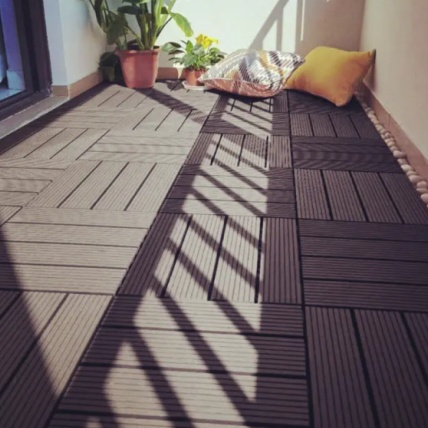
Installation basics we recommend for most projects
A big reason people love wpc decking tiles is installation simplicity. Still, the best results come from good preparation.
Step 1: Start with the right base
Most successful installations we see are on:
The base should be stable, reasonably level, and able to drain. Even the best tile can’t compensate for a shifting foundation.
Step 2: Confirm drainage
If water pools under the tiles, you risk odor, staining, and faster aging. A slight slope and drainage path usually prevents this.
Step 3: Plan expansion spacing
Composite materials can expand and contract with temperature. A small perimeter gap near walls or fixed edges helps reduce stress and buckling.
Step 4: Cut and edge finishing
If your layout needs trimming, use appropriate cutting tools and consider edge trims for a clean finish—especially on visible balcony borders or steps.
Care and cleaning without the stress
Routine care is usually simple:
Sweep debris to prevent grit wear
Wash with mild soap and water as needed
Rinse after cleaning to avoid residue
For seasonal care, remove leaf buildup and check drainage paths
What we generally discourage:
aggressive wire brushing that can damage textures
harsh chemical solvents that may affect surface appearance
pressure washing too close to the surface or at excessive force
A consistent, gentle routine tends to deliver the best long-term appearance.
Closing thoughts and where to learn more
If you’ve read this far, you’re likely looking for wpc decking tiles that don’t just look good in a catalog, but also perform well after months and years outdoors. That’s the same standard we build around: practical durability, predictable installation, and a surface that supports everyday life—coffee on the balcony, family weekends on the patio, or steady foot traffic in a commercial outdoor lounge. The best results come from matching the tile structure and surface to your environment and base condition, then installing with small details in mind like drainage and expansion gaps. If you want to explore more technical details, see design options, or discuss what tile structure fits your specific project (balcony, rooftop, poolside, or repeated installations), you can visit www.winyoungtech.com to learn more. And if you’d rather talk through your use case directly, you can also contact the team at Winyoungtech—we’re happy to share straightforward guidance and help you narrow down options without turning the conversation into a hard sell.
FAQ
1) What are the main benefits of WPC decking tiles for balcony flooring?
WPC decking tiles are often chosen for balconies because they’re quick to install, comfortable underfoot, and typically easier to maintain than many wood alternatives, while still keeping a warm, modern look.
2) How do interlocking WPC decking tiles handle outdoor drainage?
Most interlocking WPC decking tiles rely on the under-tile structure plus a draining base. For best results, install over a stable surface with a slight slope or a clear drainage path so water doesn’t pool.
3) What should I compare when choosing WPC decking tiles for long-term outdoor use?
Compare UV resistance, surface texture (especially for wet areas), locking system strength, and dimensional stability. These factors influence how the tiles look and feel after real weather exposure.
4) Can WPC decking tiles be removed and reused after installation?
Many WPC decking tiles are designed for modular use. If the locking system is robust and the tiles aren’t forced or damaged during removal, reusing them is often possible—especially for seasonal or reconfigured spaces.


