You have moved past the initial research phase. You already know co-extrusion easily outperforms first-generation composites. Right now, you hold quotes and Technical Data Sheets (TDS) from multiple manufacturers. However, a major problem remains in the market. "Co-extrusion" represents a manufacturing process. It does not automatically guarantee a specific quality standard. Manufacturers often make bold marketing claims about their products. They enthusiastically promise fade resistance or waterproof capabilities. These claims mean absolutely nothing without verifiable lab data. You need solid proof before making a long-term decision.
Our primary goal is to equip buyers with a skeptical, evidence-based framework. Contractors, architects, and informed homeowners can use this technical guide to read a TDS accurately. You will learn how to spot red flags instantly. You will confidently shortlist a reliable co-extrusion WPC decking product. This protects your capital investment. It also ensures lasting structural performance across intense seasonal shifts.
A high-quality shield layer must specify thickness and demonstrate exact UV and scratch resistance benchmarks.
Water absorption rates should realistically sit below 1% to ensure long-term structural integrity.
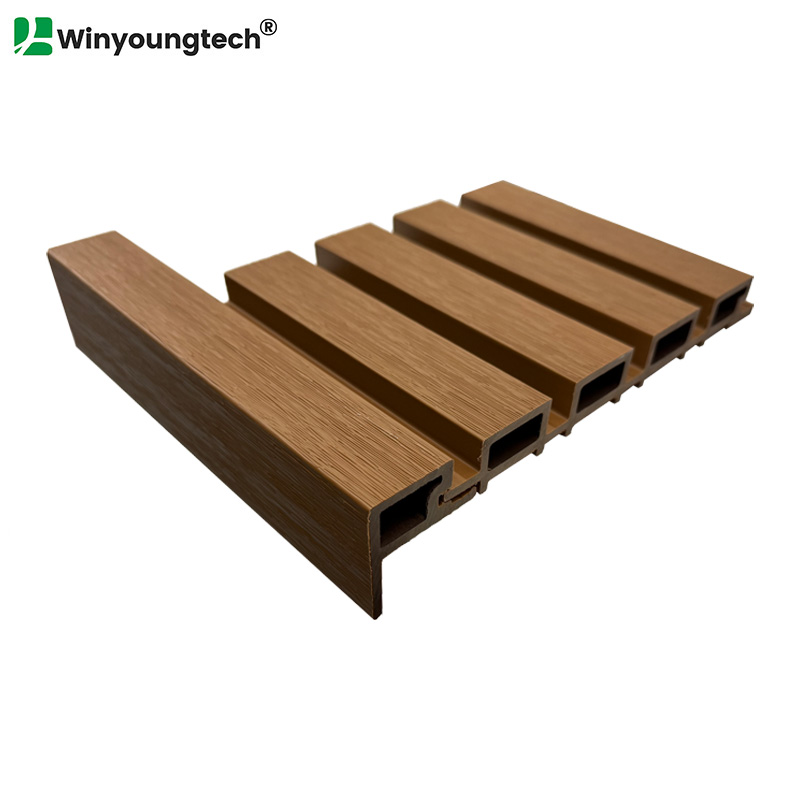
Evaluating a supplier means looking beyond the main deck boards to the specifications of co extruded wpc corner and side accessories and warranty caveats.
Demystifying Co-extrusion WPC Decking Specifications: The Shield Layer
The capping, commonly called the shield, is the defining feature of any co extrusion wpc. This outer layer protects the inner wood-plastic core from environmental damage. The technical data provided here directly dictates weatherability. It also determines your future maintenance costs.
Capping Thickness and Coverage
You must check the TDS for a uniform shield thickness. Typically, a quality shield ranges from 0.5mm to 1.5mm. A 0.5mm shield represents a budget tier. Premium boards usually feature a 1.0mm to 1.5mm thick shield. We strongly recommend noting the difference between 360-degree capping and half-capping.
360-degree capping wraps the entire board completely. It actively seals the underside against moisture rising from the ground. It also protects the inner grooves. Half-capping only covers the top surface and the sides. It leaves the bottom core exposed. Ground evaporation can easily penetrate an un-capped bottom. This trapped moisture causes upward warping over time.
Scratch and Abrasion Resistance
Do not accept vague promises about durability. Look for standardized testing metrics on the data sheet. ASTM D1044 is a common standard for testing abrasion resistance. You might also see Shore Hardness values, like Shore D. High-traffic areas require a proven baseline.
A quality shield resists heavy foot traffic. It handles dragging patio furniture and pet claws without deep gouging. If a TDS lacks abrasion test results, the manufacturer likely uses a soft polymer blend. This soft blend will scuff easily during installation.
Color Fastness and UV Resistance
"Fade resistant" is just a marketing phrase. You need real, quantifiable numbers. Look for Delta-E (ΔE) values in the specifications. Delta-E measures the visual difference between two colors over time. A lower ΔE means less noticeable color change. A ΔE value below 3.0 is practically invisible to the human eye.
Alternatively, check for specific hours of Xenon-arc testing. ISO 4892-2 is an excellent standard here. Real testing proves how long the color actually lasts under intense sun exposure. Premium manufacturers often display 2,000 to 3,000 hours of Xenon-arc testing with minimal degradation.
Common Mistake: Accepting UV data based on internal factory tests.
Best Practice: Demand external lab reports for all Delta-E claims.
Core Physical and Mechanical Metrics (The Core Matrix)
The inner core determines the overall load-bearing capacity of the board. It also dictates the longevity of your deck. A weak core will fail, even if wrapped in a premium shield.
Water Absorption Rate
This is the single most critical metric. It prevents rot, swelling, and warping. Wood fibers expand when wet. If water breaches the core, the board destroys itself from the inside. High-quality co-extrusion WPC decking specifications should display a 24-hour boiling or soaking water absorption rate below 1%. Premium tiers often hit ≤0.5%.
Laboratories test this by submerging the board in boiling water. They measure the weight and volume before and after the soak. Anything above a 1% absorption rate invites moisture into the wood fibers. This inevitably leads to structural compromise during wet seasons.
Flexural Strength (Modulus of Rupture - MOR)
Your physical safety depends on flexural strength. You must evaluate the breaking load of the boards. This directly dictates your joist spacing during installation. A higher MOR means the board spans wider gaps safely.
It prevents sagging under heavy point loads. Examples include heavy hot tubs or large planters. Always match these limits to your structural framework. If the MOR requires 300mm joist spacing, you cannot push it to 400mm to save money on substructure materials.
Density
Higher density usually means better durability. It indicates a tighter molecular bond between the wood fibers and the polymer matrix. It also points to less plasticizer migration over time. However, denser boards increase the overall weight of your deck. This requires a stronger subframe. Acceptable density ranges typically fall between 1.2 and 1.3 g/cm³. Boards below this range might feel hollow or spongy underfoot.
Standard Core Matrix Performance Benchmarks
Metric
Testing Standard
Acceptable Baseline
Premium Standard
Water Absorption
ASTM D1037 / EN 317
< 1.0%
≤ 0.5%
Flexural Strength (MOR)
ASTM D790 / EN 310
≥ 20 MPa
≥ 25 MPa
Density
ASTM D792
1.15 g/cm³
1.2 - 1.3 g/cm³
Shore Hardness
ASTM D2240
Shore D 60
Shore D 65+
Climate Adaptability and Implementation Risks
A product might perform perfectly in a controlled lab setting. It can still fail during real-world seasonal shifts. Thermal limits must be respected by installers. Ignoring these limits ruins otherwise excellent materials.
Coefficient of Linear Thermal Expansion (CLTE)
This represents a critical implementation risk. WPC naturally expands in extreme heat. It naturally contracts in extreme cold. The TDS must provide an exact CLTE value. Installers use this number to calculate gap sizes. They need precise spacing between board ends.
Proper spacing prevents buckling during summer heatwaves. It also prevents tearing at the fastener points during winter contraction. If a supplier cannot provide a CLTE value, they do not understand material science. You should walk away immediately.
Freeze-Thaw Resistance
Colder climates demand specific attention. You must verify if the data sheet includes cyclic freeze-thaw testing. Water expands when it freezes. If minimal moisture enters the core, freezing temperatures can destroy the board internally.
Cyclic testing ensures the core and shield do not delaminate under extreme temperature drops. The lab subjects the board to repeated freezing and thawing cycles. They then re-test the flexural strength. A good product retains at least 80% of its original strength after these cycles.
Slip Resistance
Slip resistance is a strict compliance and safety issue. Commercial pools, public boardwalks, and restaurant patios require high traction. Look for standardized R-ratings in the technical data. Ratings of R10 or R11 are excellent for wet areas.
You might also see Pendulum Test Values (PTV) based on EN 16165. A PTV above 36 indicates a low slip potential. Do not assume a textured wood-grain surface automatically guarantees safety. Some deep embossing actually creates slippery pockets when filled with algae or soapy water.
Check CLTE: Calculate your regional temperature swing (e.g., -10°C to +40°C).
Verify Frost Data: Look for delamination reports if you live in a snowy region.
Confirm R-Rating: Match the slip resistance to the specific use case (e.g., poolside vs. dry balcony).
Evaluating System Completeness: Accessories and Finishing Details
A premium deck installation involves much more than just the primary surface boards. You need a complete, cohesive system. Many buyers overlook the technical data of the accessories. This creates major aesthetic issues down the line.
Matching Accessory Specifications
Always check if the TDS explicitly covers accessory items. This includes fascia boards, step treads, and specialized finishing profiles. Specifically, verify the data for your co extruded wpc corner and side accessories. These edge pieces often take the most physical abuse from foot traffic and lawnmowers. They also face direct UV exposure on elevated decks.
Material Consistency
The accessories must share the identical co-extrusion technology. They require the exact same weatherability specs as the primary decking. Using first-generation or un-capped profiles for edges is a common tactic. Some suppliers do this to cut manufacturing costs.
We see this often in the industry. It quickly leads to uneven fading. Your main deck stays vibrant for decades, while the edges turn gray in a single year. Furthermore, fascia boards endure different thermal stress because they are often pinned vertically. They need dedicated installation guidelines and equivalent flexural strength data.
How to Shortlist a Reliable Co-extrusion WPC Decking Supplier
Eventually, you must shift your focus. You move from evaluating the product to evaluating the business partner. A great product on paper means nothing if the company fails to deliver or honor their agreements.
Third-Party Verification
A trustworthy co-extrusion WPC decking supplier readily provides unredacted test reports. They source these from recognized independent labs. Look for names like SGS, TUV, or Intertek. They should test against rigorous ASTM or EN standards.
Self-published marketing brochures do not count as proof. Factory-issued certificates are easily manipulated. An honest supplier will email you the full PDF report directly from the lab. This transparency is a massive green flag.
Warranty Caveats
Read the fine print closely. Warranties often hide harsh realities. Does the warranty cover labor and replacement costs? Many only cover the raw material itself. If your deck fails, they ship you new boards, but you pay thousands to rebuild it.
Pay close attention to strict installation caveats. Some warranties enforce maximum joist spacing limits. Others require specific gap sizing based on the CLTE. If your installer ignores these exact metrics, you instantly void the warranty. A good supplier highlights these limits clearly rather than burying them.
Next-Step Action
Always request physical samples alongside the full lab reports. You must cross-reference them manually. Feel the physical weight. Inspect the finish and the embossing quality. Measure the shield thickness yourself using digital calipers. Ensure the physical item in your hand matches the paper data exactly. If the TDS claims a 1.2mm shield, but the sample measures 0.5mm, you have exposed a dishonest supplier.
Conclusion
Evaluating technical data is an exercise in strict risk mitigation. It goes far beyond simple feature comparison or color selection. You must look past marketing buzzwords and focus heavily on hard metrics. Monitor water absorption limits carefully. Calculate thermal expansion coefficients based on your local climate. Always demand independent testing for UV and scratch resistance.
By following these specific steps, buyers effectively protect their capital investment. They avoid costly tear-downs and frustrating warranty disputes. We urge you to take action today. Compare your current supplier quotes against the standard benchmarks outlined in this guide. Request full, unredacted independent lab reports before you sign any contract or wire any deposit.
FAQ
Q: What is an acceptable water absorption rate for co-extrusion decking?
A: Generally, below 1%, with premium tiers achieving ≤0.5%. Anything higher risks freeze-thaw damage and warping.
Q: Do I need 360-degree capping, or is partial capping enough?
A: 360-degree capping offers superior moisture protection from the substructure, whereas un-capped bottoms can absorb moisture from ground evaporation.
Q: Why does the thermal expansion coefficient matter for installation?
A: It dictates the mandatory gap size between board ends. Ignoring this metric leads to buckling in summer or tearing at the fasteners in winter.