Sending a vague Request for Quotation (RFQ) for commercial decking guarantees one outcome. You get wildly inconsistent pricing and apples-to-oranges supplier responses. Sourcing managers often receive quotes looking incredibly cost-effective on paper. However, these products routinely fail during installation. They suffer from poor span ratings, hollow core weaknesses, or inadequate capping. Such failures derail project timelines and ruin construction budgets.
To identify a reliable partner and secure accurate pricing, your RFQ must mandate specific data. You need precise dimensional, structural, and compliance metrics. You cannot leave critical technical parameters open to supplier interpretation. This guide outlines the exact parameters you must include in your next procurement cycle. By demanding precise material data upfront, you protect your projects from hidden defects. We show you how to structure your RFQ, evaluate incoming bids, and confidently separate top-tier manufacturers from low-quality trading companies.
Key Takeaways
- Specify exact dimensions, structural profiles (solid vs. hollow), and acceptable tolerance margins to ensure installation uniformity.
- Require data on material composition, specifically co-extrusion shield thickness and core density, to verify long-term durability.
- Demand certified third-party testing for load-bearing capacity, span ratings, and UV/fade resistance to mitigate project risk.
- Include associated hardware (clips, joists) and warranty realities in the RFQ to calculate the true Total Cost of Ownership (TCO).
The Business Risk of Ambiguous WPC Decking Specifications
Asking for standard materials creates massive procurement risks. It allows low-tier manufacturers to quote first-generation, uncapped composites. Some suppliers use excessive filler materials to intentionally drop their prices. You cannot evaluate these bids fairly when baselines differ drastically. Discrepancies in density or structural profiles always lead to hidden expenses later.
For example, weaker boards need closer joist spacing to prevent sagging. This requirement heavily increases your substructure material and labor expenses. You might also deal with high thermal expansion rates. These expansion issues cause warping, buckling, and snapped fasteners. A well-structured RFQ prevents these unpleasant surprises entirely. It forces suppliers to declare their technical ceilings upfront.
Precise data requirements naturally separate premium composite decking manufacturers from mere trading companies. When you mandate strict performance parameters, you force transparency across the board. You quickly weed out factories incapable of meeting commercial safety standards. Buyers gain tremendous leverage by standardizing their technical expectations early in the sourcing process.
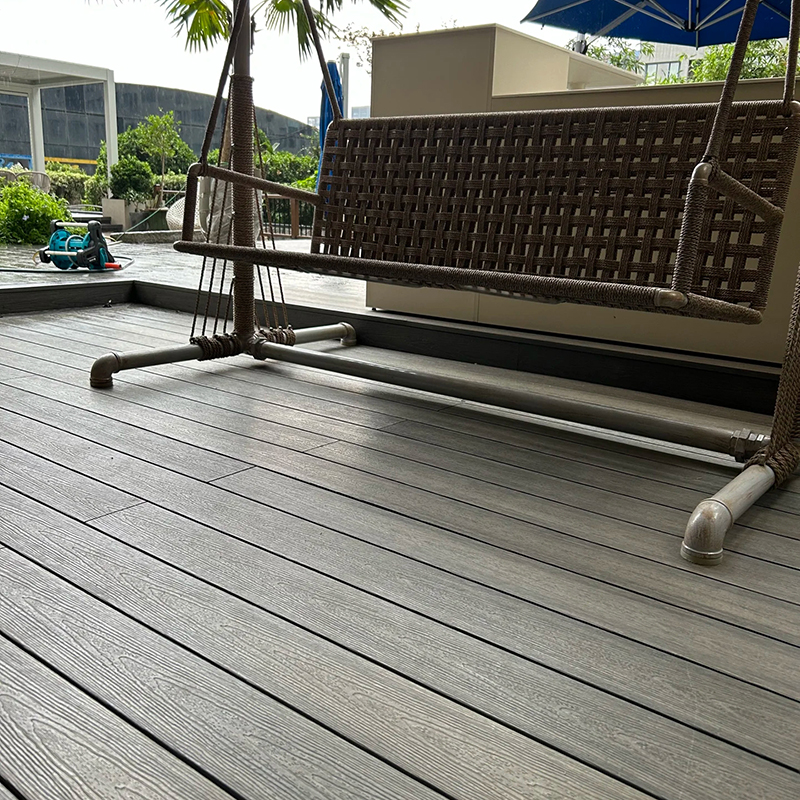
Essential Physical and Dimensional Specifications
You must lock down exact physical dimensions in your initial RFQ. Require specific length, width, and thickness parameters from every bidder. A common industry standard features a 2.9m length, 140mm width, and 23mm thickness. However, you must align these metrics strictly to your architectural plans. Explicitly state your required structural profile types in the document.
Solid boards handle high-traffic environments and heavy commercial loads perfectly. Hollow boards offer significant cost savings for residential or light-duty applications. Always ask the WPC decking supplier for their exact manufacturing tolerance limits. Acceptable variances for length, width, and bowing determine final installation quality. Tight manufacturing tolerances ensure uniform gaps and perfectly straight lines.
Finally, specify the required surface finish for your project. Do you need a 3D wood grain, a brushed texture, or deep grooves? Clarify whether the boards require single-sided or double-sided aesthetic treatment. Double-sided boards offer versatility during installation, allowing crews to flip damaged faces.
Table 1: Solid vs. Hollow Profile Application Matrix
| Profile Type | Primary Application | Structural Strength | Weight per Meter | Budget Impact |
| Solid Core | Commercial, Public Parks, Boardwalks | High (Minimal Deflection) | Heavy | Higher Initial Investment |
| Round Hollow | Residential, Light Commercial | Medium (Good Balance) | Moderate | Cost-Effective |
| Square Hollow | Private Balconies, Patios | Standard (Requires Closer Joists) | Lightweight | Most Economical Option |
Material Composition and Performance Metrics
Material ratios dictate exactly how long your decking installation lasts. First, specify the generational technology you expect from the manufacturer. Traditional first-generation composites lack a protective outer shell. These older boards absorb moisture easily and stain under heavy use. Co-extruded or capped second-generation boards offer superior stain and fade resistance.
If you request capped boards, mandate the minimum polymer shield thickness. We recommend specifying 360-degree capping featuring a minimum 0.5mm thickness. Next, request the exact product weight per linear meter. Low density usually indicates poor material ratios inside the core. Excessive wood flour or cheap recycled plastics compromise overall board strength. A balanced composition prevents premature brittleness in freezing climates.
You also need concrete physical performance data from the factory. Require specific testing data on maximum load-bearing capacity. Demand the maximum allowable joist spacing before downward deflection occurs. Engineers call this critical metric the span rating. Accurate span ratings keep your structural designs safe and compliant.
Include these key material performance requirements in your RFQ:
- Minimum core density (measured in kg/m³).
- Exact polymer-to-wood filler ratio (e.g., 60% wood, 30% HDPE, 10% additives).
- Co-extrusion shield thickness and specific polymer material type.
- Flexural strength limits tested under standardized laboratory conditions.
Safety, Compliance, and Environmental Standards
Commercial installations require strict safety compliance to pass local building inspections. Mandate specific testing standards in your primary RFQ document. Ask for European (CE) or American (ASTM) laboratory test reports. Fire retardancy proves critical for public spaces and multi-family housing. Request documented proof of Class B or Class C fire ratings.
Slip resistance also protects pedestrians walking in wet conditions. Require R10 or R11 slip resistance ratings for outdoor commercial zones. Weathering performance dictates long-term maintenance needs and replacement cycles. Require empirical data on product water absorption rates. Top-tier WPC decking specifications show absorption rates remaining well below 1%.
Ask for thermal expansion coefficients to anticipate board movement in extreme climates. Without this data, boards expand and snap their holding clips during summer heatwaves. Environmental certifications matter immensely for corporate and government projects. Specify your need for FSC (Forest Stewardship Council) certification if required.
You should also request recent ISO 9001 and ISO 14001 audit records. Verify REACH compliance to ensure the WPC decking uses non-toxic formulations. This certification guarantees factories utilize safe recycled materials free from dangerous heavy metals.
Installation Hardware and Warranty Realities
Mismatched installation hardware causes most post-installation failures. Your RFQ must deeply cover the exact fastening systems required. Clarify whether you need hidden fasteners or traditional face-screwing systems. Specify whether the clips should utilize marine-grade stainless steel or heavy-duty plastic. Ask for dedicated starter clips for securing edge boards perfectly.
Sourcing a compatible wpc decking clip system directly from the same factory prevents future warranty disputes. Substructure compatibility requirements also heavily affect your procurement strategy. Ask if the manufacturer provides matching composite or aluminum joists. You must know the mandatory joist spacing required to keep the factory warranty active.
Request the official warranty documentation upfront during the bidding phase. Do not wait until the final contract stage to read the fine print. Many suppliers offer warranties looking impressive on page one. However, the exclusions listed on page three often void coverage for minor installation deviations.
Evaluate incoming warranty terms using these strict criteria:
- Commercial coverage lengths versus residential coverage lengths.
- The exact technical definition of a "valid claim" regarding color fading.
- Specific warranty exclusions related to improper hardware usage.
- Provisions detailing labor cost coverage in the event of total material failure.
- Mandatory gapping requirements needed to accommodate normal thermal expansion.
How to Evaluate and Shortlist Supplier Quotes
Once quotes arrive on your desk, apply strict evaluation criteria immediately. Dismiss proposals lacking detailed technical data sheets (TDS). Reputable manufacturers always provide structural testing data voluntarily. You should also flag glaring pricing anomalies immediately. If a quote sits 20% below the established market average, look closely.
Unless the supplier justifies this drop through reduced specifications, they are cutting manufacturing corners. Make sample verification a rigid, non-negotiable condition for your final shortlist. State clearly how bulk production must perfectly match a pre-approved physical sample. Test this arriving sample for density, color matching, and deep scratch resistance.
You can perform a simple water boil test to check moisture absorption. You can also drag a coin across the surface to evaluate the capping durability. Establish a clear, rigid timeline for all next steps. Outline exactly when you will review initial quotes and conduct physical sample testing.
Plan to audit the manufacturer's facility via video call if possible. Review their ISO audit records and quality control checklists before finalizing any contract. Checking their actual extrusion lines ensures they possess true manufacturing capacity, rather than just outsourcing your order to cheaper sub-factories.
Conclusion
An RFQ acts as a vital protective barrier for your entire procurement process. Dictating precise physical and chemical specifications shifts the burden of proof onto the supplier. You force them to prove their technical capabilities long before price negotiations even begin. Ambiguity only benefits low-quality manufacturers looking to exploit specification gaps.
Take these concrete action steps for your next procurement cycle. First, use the physical, structural, and compliance parameters outlined above as your baseline template. Second, request all third-party laboratory test reports alongside the initial pricing submissions. Third, order physical samples and stress-test them against the declared technical data sheets. Finally, audit the warranty text for unreasonable installation exclusions.
Standardizing your requests ensures fair, accurate bid comparisons. You end up evaluating true material quality and reliable supply capabilities. By controlling the technical narrative, you move beyond just comparing bottom-line prices. You secure durable materials guaranteed to perform successfully across their intended lifespan.
FAQ
Q: What is the standard MOQ (Minimum Order Quantity) I should expect in a WPC decking RFQ?
A: Standard MOQs typically range from one 20ft shipping container, which equals approximately 800 to 1000 square meters. Factories require this volume to justify configuring their extrusion lines. If you request standard inventory colors, some suppliers might lower the MOQ. Custom lengths or unique color profiles will strictly enforce the full container requirement.
Q: Should I ask for traditional or co-extruded WPC decking in my RFQ?
A: It depends on your project budget and application. Traditional boards cost less upfront but require higher maintenance to prevent staining. Co-extruded boards feature a protective polymer cap, making them highly stain, fade, and scratch-resistant. We highly recommend co-extruded options for commercial spaces requiring low-maintenance longevity.
Q: How do I verify the load-bearing capacity claims of a WPC decking supplier?
A: Never accept undocumented claims. Advise your sourcing team to demand independent laboratory test reports from recognized bodies like SGS or Intertek. These reports must reference specific ASTM or EN testing standards for flexural strength. The documents should explicitly list the maximum load limits and recommended span ratings before deflection occurs.


